



 13 min.

Facelift recovery is one of the most important yet least understood parts of facial rejuvenation surgery. While much attention is given to the surgical technique itself, the healing process that follows plays an equally critical role in how natural, comfortable, and long-lasting the final result appears.
Recovery after a facelift is not a single event but a progression. Swelling, tightness, and changes in sensation evolve over time, and these changes differ depending on the depth of surgery, the areas treated, and the specific facelift technique used. Understanding what typically happens during the first days, the following weeks, and the settling period over several months can reduce anxiety and help patients plan their recovery more confidently.
In this article, we walk through facelift recovery step by step, from the immediate post-operative phase to longer-term healing. We also explain how recovery can differ between deep plane, full, lower, and mini facelift procedures, helping you understand what is normal for your specific treatment.
What Influences Facelift Recovery?
Facelift recovery varies significantly from one patient to another. While timelines provide useful guidance, several factors determine how quickly swelling resolves, how comfortable recovery feels, and how soon results begin to look natural.
Key factors that influence facelift recovery include:
- Depth of the surgical technique: Procedures that involve deeper tissue layers generally require more internal healing, even if visible swelling resolves at a similar pace.
- Type of facelift performed: A mini facelift typically involves less extensive dissection than a full or deep plane facelift, which can affect early recovery and downtime.
- Areas treated: Surgery focused on the lower face and jawline may feel different during recovery than procedures that also address the cheeks and midface.
- Individual healing response: Age, skin quality, circulation, and overall health influence swelling, bruising, and tissue adaptation.
- Post-operative care and compliance: Following recovery instructions, including rest, positioning, and activity restrictions, plays a major role in how smoothly healing progresses.

Facelift Recovery by Procedure Type
Before looking at recovery day by day, it helps to understand how different facelift techniques generally influence the healing process. While all facelifts involve swelling and tissue adjustment, the extent and duration can vary.
- Deep Plane Facelift: This technique works at a deeper structural level of the face. Although early swelling may not be dramatically different from other facelifts, internal healing continues for a longer period. Patients often notice gradual, natural-looking improvement as tissues settle over time. For a deeper understanding of how this technique works and why its recovery follows a longer internal healing pattern, see What Exactly Is a Deep Plane Facelift Method? Do You Need It?.
- Full Facelift: A full facelift addresses multiple areas of the face and neck. Recovery involves moderate swelling and tightness, with visible improvement appearing steadily over several weeks. Patients comparing recovery expectations between broader facial correction and more targeted approaches may find it helpful to review Full Facelift vs Lower Facelift for additional context.
- Lower Facelift: Focused on the jawline and lower face, this procedure tends to cause more localized swelling and tightness in the neck and lower cheeks, with a recovery pattern concentrated in those areas.
- Mini Facelift: Because it involves less extensive tissue dissection, a mini facelift usually allows for a faster return to daily activities, although subtle swelling and tightness can still persist for weeks. For a detailed explanation of why recovery is often quicker with this approach and who it is best suited for, see What Is a Mini Facelift? Who It’s For and What to Expect.
These differences do not mean that one procedure is “easier” or “harder” overall. Instead, they highlight why recovery should always be discussed in relation to the specific facelift technique performed.
Facelift Recovery: The First 72 Hours (Days 1-3)
The first three days after a facelift represent the most intensive phase of recovery. During this time, the body responds to surgery with swelling, fluid shifts, and temporary discomfort as healing begins.

Most patients experience:
- Swelling and tightness across the treated areas
- Bruising that may begin to appear around the jawline, cheeks, or neck
- A sensation of pressure rather than sharp pain
- Fatigue related to anesthesia and the body’s healing response
Dressings or compression garments are commonly used during this phase to support tissues and control swelling. Some patients may have surgical drains, depending on the technique used, which are typically removed early in recovery.
Differences between facelift types are often subtle at this stage. While a mini facelift may feel slightly less intense, deep plane and full facelifts can feel similarly tight in the early days. The key distinction is that deeper procedures continue healing internally long after visible swelling begins to improve.
Rest, head elevation, and limited movement are essential during this period. Most patients are encouraged to walk gently but avoid bending, lifting, or sudden facial movements.
Facelift Recovery: Days 4-7 (End of Week One)
As the first week progresses, most patients begin to notice gradual improvements in comfort and mobility. While swelling and bruising are still present, the most intense phase of recovery typically starts to ease during this period.
Common experiences during days four to seven include:
- Swelling that begins to feel less tight or firm, although it may shift to different areas of the face or neck
- Bruising becoming more visible before it starts to fade, often moving downward due to gravity
- Improved comfort, with many patients needing less pain medication
- A growing sense of facial stiffness rather than soreness
By this stage, many patients have follow-up appointments to assess healing, remove dressings, or take out sutures if non-dissolvable stitches were used. Drains, if placed, are usually removed earlier, which can make movement feel easier.
Facelift type can influence how patients feel at the end of week one. Those who have had a mini facelift often notice earlier reductions in swelling and may feel more socially present sooner. Patients recovering from full or deep plane facelifts may still feel noticeably tight, especially around the jawline and neck, even if visible swelling is starting to improve.
It is also common to experience temporary numbness or altered sensation during this phase. This is a normal part of nerve recovery and does not indicate a problem as long as it is not accompanied by increasing pain or swelling.
Although many patients feel better by the end of the first week, it is important to continue resting and avoiding strenuous activity. Returning to normal routines too quickly can prolong swelling and delay overall healing.
Facelift Recovery: Weeks 2–3
Weeks two and three mark a noticeable transition in facelift recovery. During this phase, patients often feel significantly better than they did in the first week, even though healing is still very much underway beneath the surface.
By this point, many of the most visible signs of surgery begin to improve. Bruising typically fades substantially, although faint discoloration may still be present, especially around the neck or lower jaw. Swelling continues to decrease but can fluctuate throughout the day, sometimes appearing more pronounced in the evening.
Common experiences during weeks two to three include:
- Residual swelling that feels softer and less tense than in earlier stages
- Facial stiffness, particularly when smiling or turning the head
- Areas of numbness or tingling as nerves continue to recover
- Increasing confidence moving around in public or returning to light routines
Many patients feel comfortable returning to desk work or non-physical daily activities during this period. Social downtime often decreases, especially for those who have had a mini facelift or a more localized lower facelift. Makeup can usually be used to conceal remaining bruising once incisions have healed adequately and surgeon approval is given.
Differences between facelift types become more apparent during this stage. Mini facelift patients often feel closer to normal and may resume more activities sooner. Those recovering from full or deep plane facelifts may still feel internal tightness or uneven firmness, even if they look relatively settled on the surface. This is a normal part of deeper tissue healing.
Although progress feels encouraging during weeks two and three, it is important to remain patient. Exercise, heavy lifting, and activities that raise blood pressure are still limited to avoid prolonging swelling or disrupting healing tissues. The face may look “almost there,” but internal recovery is still ongoing.
This stage is best viewed as the beginning of visible recovery rather than the end of healing.
Facelift Recovery: Weeks 4–6
Weeks four to six represent a turning point in facelift recovery. During this phase, most patients feel noticeably more comfortable in their day-to-day lives, even though healing is still continuing beneath the surface. The face begins to feel more familiar, and the results start to look more settled and natural.
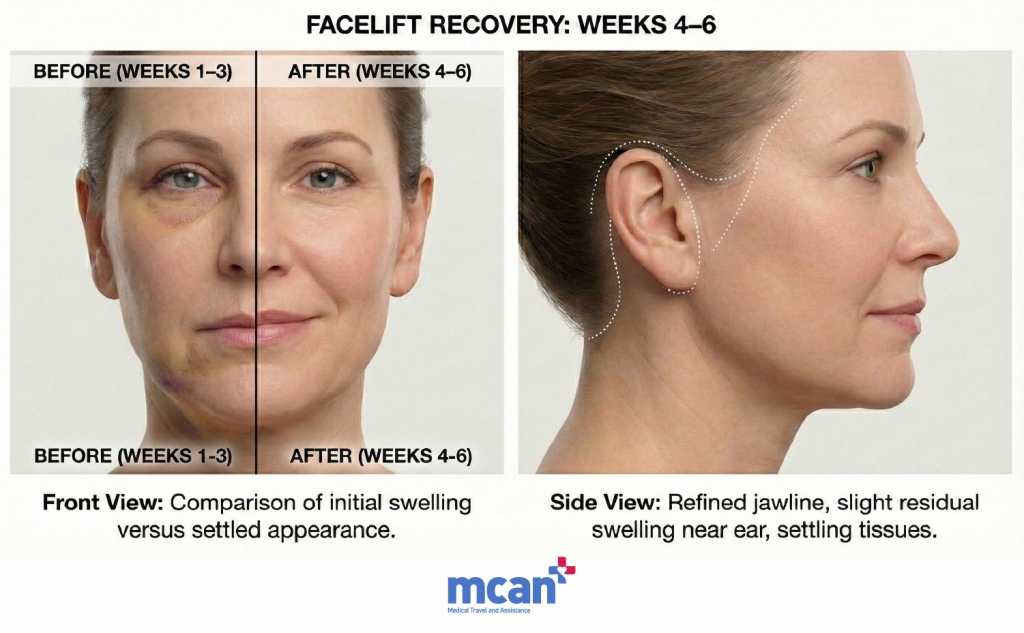
Swelling at this stage is usually mild and localized. It may still appear along the jawline, under the chin, or near the ears, particularly in the morning or after increased activity. Facial tightness often improves, though some stiffness can remain when making expressive movements.
Common changes during weeks four to six include:
- A more natural facial appearance as swelling subsides
- Improved comfort when speaking, smiling, and turning the head
- Gradual return of normal skin sensation, though numbness may persist in small areas
- Increased confidence in social settings without the need to conceal signs of surgery
Many patients are cleared to resume light to moderate exercise during this period, depending on their surgeon’s guidance. Activities such as walking, gentle cycling, or stretching are often allowed first, with more intense workouts introduced gradually. Returning to normal routines should still be paced to avoid triggering prolonged swelling.
Differences between facelift types continue to be relevant. Patients who underwent a mini facelift often feel nearly back to normal by this stage. Those who had a full or deep plane facelift may still notice internal tightness or firmness, even if the outward appearance looks calm and refined. This internal healing is expected and can continue for several more months.
It is also common for patients to notice small asymmetries or areas that feel different from one side to the other. These differences usually resolve as tissues continue to adapt and settle. Judging final results too early during this phase can lead to unnecessary concern.
By the end of week six, most patients feel fully engaged in daily life again, even though their facelift results will continue to refine with time.
Facelift Recovery: Months 2–3
By months two and three, facelift recovery enters a more refined phase. Most visible signs of surgery have resolved, and patients generally feel comfortable, confident, and fully reintegrated into their normal routines. At this stage, the face looks less “post-surgical” and more naturally refreshed.
Swelling during this period is typically minimal and subtle. It may still appear in specific areas such as under the chin, along the jawline, or near incision sites, but it is usually not noticeable to others. Facial tightness continues to ease as tissues soften and adapt to their new position.
During months two to three, patients often notice:
- Facial contours that appear smoother and more balanced
- Improved softness and flexibility in the skin
- Continued return of normal sensation, with numbness limited to small areas
- Increased comfort with facial expressions and movement
Scar healing also becomes more apparent during this phase. Incision lines often begin to fade from red or pink tones to lighter shades, and the surrounding skin blends more naturally. Proper scar care, sun protection, and adherence to aftercare recommendations remain important to support this process.
Differences between facelift types are still relevant. Mini facelift patients often feel fully recovered by this point, with only minor residual tightness. Patients who have undergone a full or deep plane facelift may still notice deeper internal healing sensations, even though their outward appearance looks settled. This is normal and reflects the extended healing required for deeper tissue work.
It is also common for patients to experience subtle fluctuations in how their face feels from day to day. These changes usually relate to activity level, hydration, and circulation rather than any issue with the surgery itself.
By the end of month three, most patients feel that their facelift results look natural and stable, even though refinement will continue gradually over the following months. This stage often marks a shift from “recovery” to simply living with the results.
Facelift Recovery: Months 4–6 and Beyond
From month four onward, facelift recovery is largely about refinement rather than healing in the traditional sense. By this stage, most patients feel fully comfortable in their appearance and daily life, with the face looking settled, natural, and balanced.
Any remaining swelling during this period is usually very mild and limited to deeper tissues. It is often noticeable only to the patient and may fluctuate slightly with activity, temperature, or hydration. The skin continues to soften, and facial movement feels increasingly natural as tissues fully adapt.
During months four to six and beyond, patients typically experience:
- Final contour refinement along the jawline, cheeks, and neck
- Continued softening of firmness beneath the skin
- Scars that fade further and blend more naturally with surrounding skin
- A stable facial appearance that reflects the intended surgical outcome
At this stage, differences between facelift types become less about recovery and more about result longevity. Mini facelifts tend to reach their final appearance earlier, while full and deep plane facelifts may continue to show subtle improvements over a longer period due to deeper structural healing.
Patients who have undergone deep plane or full facelift procedures often report that their results continue to “age well,” with improvements becoming more natural rather than more noticeable over time. This gradual settling is considered a positive aspect of deeper techniques rather than a delay in recovery.
By six months, facelift results are generally considered mature, even though minor internal changes can continue for up to a year. Most patients no longer think in terms of recovery and instead focus on enjoying their refreshed appearance and restored confidence.
Understanding this long-term phase helps patients appreciate that facelift recovery is a process with stages, not a single endpoint. Patience during the early months is rewarded with results that look settled, natural, and consistent with the face’s natural expressions.
Recovery Differences by Facelift Type
While all facelift procedures follow the same general healing stages, the pace and feel of recovery can differ depending on the technique used. These differences are mainly related to how deeply tissues are repositioned and how many areas of the face are addressed.
The table below offers a practical comparison of recovery patterns across common facelift types. Timelines are approximate and meant to illustrate trends rather than fixed rules, as individual healing varies.
Recovery Comparison Based on Facelift Type
| Facelift Type | Initial Swelling & Bruising | Return to Light Activities | Tightness Duration | When Results Look Natural |
|---|---|---|---|---|
| Mini Facelift | Mild to moderate | 7–10 days | Short-term | 3–4 weeks |
| Lower Facelift | Moderate, localized to jawline and neck | 10–14 days | Moderate | 4–6 weeks |
| Full Facelift | Moderate to significant | 2–3 weeks | Longer-lasting | 6–8 weeks |
| Deep Plane Facelift | Moderate, often similar externally to full facelift | 2–3 weeks | Longer internal healing | 8–12 weeks |
For readers who want a broader understanding of how these facelift techniques compare beyond recovery alone, The Ultimate Guide to Facelift Procedures: Which One Is Right for You? provides a detailed overview of the different options and how they are selected based on anatomy, goals, and ageing patterns.
Common Facelift Recovery Concerns and Reassurance
During facelift recovery, it is normal to notice changes that feel unfamiliar or worrying at first. Many of these experiences are part of the healing process and improve gradually as swelling resolves and tissues settle:
Facial Tightness or Stiffness
A feeling of tightness is one of the most common sensations after a facelift, especially during the first few weeks.
- Often more noticeable after full or deep plane facelifts
- Can persist even when swelling looks minimal
- Softens gradually as internal healing progresses
- Does not mean the face is permanently tight or overcorrected
Temporary Asymmetry
It is very common for one side of the face to heal faster than the other.
- One side may appear more swollen or firmer
- Differences are often related to swelling patterns or sleeping position
- Symmetry usually improves steadily over weeks to months
Numbness or Altered Sensation
Changes in sensation are expected as nerves recover.
- Common around the ears, jawline, and neck
- Tingling or sensitivity can occur as feeling returns
- Full sensation may take several months to normalize
Bruising Changes
Bruising often changes in appearance before it fades.
- Color shifts from dark to yellow or green are normal
- Bruising may move downward due to gravity
- This progression does not indicate delayed healing
Scar Concerns
Early scar appearance can be misleading.
- Scars may look red, raised, or firm in the early weeks
- Appearance typically improves over several months
- Early visibility does not reflect the final scar outcome
Emotional Ups and Downs
Recovery can affect mood as well as appearance.
- Fatigue and swelling can impact confidence temporarily
- Emotional fluctuations are common in the early stages
- Mood usually improves as comfort and appearance stabilize
When to Contact Your Surgeon
Most recovery concerns are normal, but medical guidance should be sought if you experience:
- Increasing pain instead of gradual improvement
- Sudden or rapidly worsening swelling
- Signs of infection such as redness, warmth, or fever
- Concerns that do not improve with time
For patients who are still deciding whether facelift surgery is the right step for them, Is a Facelift the Right Choice for You? Key Signs to Consider, Questions Answered offers helpful guidance on candidacy, expectations, and common concerns before surgery.
Exceptional Recovery Follow-up for Your Facelift in Turkey with MCAN Health
Facelift recovery is a gradual process that unfolds over weeks and months, and understanding this timeline is just as important as choosing the right surgical technique. At MCAN Health, facelift procedures are planned with recovery in mind from the very beginning, taking into account not only the type of facelift performed but also how each stage of healing will realistically affect daily life.

Patients travel to Turkey for facelift surgery with MCAN Health because recovery is approached as a structured, supported phase rather than an afterthought. From early swelling management to long-term scar maturation and tissue settling, every step is guided with clarity and ongoing medical oversight.
Key elements of facelift in Turkey experience include:
- Experienced Facial Surgeons who select facelift techniques based on both desired results and predictable recovery patterns, whether a mini, lower, full, or deep plane facelift is performed
- Accredited Surgical Facilities, with all procedures carried out in TEMOS-accredited and internationally certified hospitals that meet strict safety and hygiene standards
- All-Inclusive Treatment Planning, covering surgery, accommodation, transfers, medications, and in-hotel nurse visits to reduce stress during the early recovery phase
- Multilingual Patient Support, ensuring patients understand what is normal at each recovery stage and when to seek reassurance or guidance
- UK-Based Aftercare Office, offering continuity of care once patients return home and supporting recovery through the later months
Care That Supports a Predictable Recovery
Recovery does not end when swelling subsides. MCAN Health’s care structure is designed to support patients well beyond the initial healing phase:
- MCANCare provides nurse-led support and monitoring during the most sensitive early days after surgery
- MCANFollow offers a structured 12-month follow-up program to track healing, sensation changes, and scar progression
- MCANAssurance adds an additional layer of reassurance in the unlikely event that further care is required
With MCAN Health, facelift recovery is approached with patience and realism. Rather than rushing results or setting unrealistic timelines, the focus is on guiding patients through each stage of healing so that outcomes settle naturally, facial movement feels comfortable again, and results remain consistent with the patient’s features over time.


 MCAN Health Announces Opening of New Office in London
  Unraveling The Science of Smell: Exploring the Potential Influence of Nose Shapes on Olfactory Perception
  What Exactly is a Deep Plane Facelift Method? Do You Need It?