



 10 min.

Buttocks play an important role in overall body proportion and silhouette. Buttock shape can influence everything from how clothing fits to how the waist and hips appear in relation to each other.
And since you’re reading about butt shapes, you’re probably curious about which category you fall into. What many people don’t realize is that understanding your natural buttock shape can also help you set realistic expectations about what exercise can achieve and what kinds of aesthetic procedures may be more suitable depending on your anatomy.
In this article, we will provide useful insight into common buttock shapes and what determines them from an anatomical point of view, including how fat distribution, muscle structure, and pelvic shape contribute to overall contour.
We will cover:
- What determines the shape of your butt
- The different shapes based on commonly used clinical classifications
- How buttock shape often relates to overall body proportions
- The most common ways to change buttock size and contour (from exercise to surgical options)
What Shapes Butt Shapes?

Like all other parts of the human body, the shape and form of the buttocks are determined by a combination of anatomical factors, including:
- Skeletal structure
- Muscular mass
- The way the body distributes and stores fat
The pelvis is the main bone shaping the form of the buttocks. Its width, angle, and orientation are largely determined by genetics, with some influence from nutrition and physical development during childhood and adolescence. This underlying structure plays a central role in how the buttocks project, how wide they appear, and how soft tissue is supported.
Contrary to popular belief, muscle mass usually plays a limited role in determining overall buttock shape unless someone engages in intensive, long-term strength training. While exercise can improve firmness and tone, it does not significantly alter pelvic anatomy or redirect fat placement. Fat distribution has a much greater impact on shape, whether fat accumulates more on the sides, lower portion, or is more evenly distributed across the gluteal area.Although genetics plays the leading role, many patients ask whether it is possible to change their buttock shape. From a clinical perspective, this is an important distinction. Lifestyle changes may influence volume, but they do not change pelvic structure or allow controlled reshaping of contours. This is where Brazilian Butt Lift (BBL) becomes relevant. By using fat transferred from other areas of the body, BBL allows surgeons to work within the patient’s existing anatomy, enhancing projection, fullness, and balance in areas where fat is naturally lacking, while respecting the limits set by skeletal structure and tissue quality.

Butt Shapes: The Big 4

In aesthetic plastic surgery, buttock shape classification is not just descriptive. It plays a practical role in evaluating anatomy, setting realistic expectations, and planning procedures such as fat transfer or body contouring. One of the most widely referenced classification systems is attributed to Matthew Schulman, an American plastic surgeon who has evaluated and treated tens of thousands of patients across different body types and ethnic backgrounds.
From a clinical standpoint, identifying buttock shape helps surgeons understand:
- How fat is naturally distributed
- Where volume is lacking or excessive
- How the buttocks relate to the waist, hips, and thighs
This information directly influences whether a patient is a good candidate for procedures such as Brazilian Butt Lift (BBL), which areas can safely receive transferred fat, and how to achieve balanced proportions rather than artificial-looking volume.
Below are the four most commonly described buttock shapes and how each is approached in aesthetic planning:
The Bubble Butt (Round Butt)

A round or bubble-shaped buttock has relatively even volume distribution between the upper and lower gluteal regions, creating natural projection and smooth contours. From a surgical perspective, this shape often requires refinement rather than dramatic change. In patients seeking enhancement, fat transfer is typically used to subtly increase projection or improve symmetry while preserving the existing round contour. Because volume is already well distributed, overcorrection is carefully avoided to maintain natural proportions.
The Heart Shaped Butt (Pear Shaped Butt)

Heart-shaped buttocks are fuller in the lower portion, with volume tapering toward the waist. This creates a soft, curving silhouette that many patients wish to preserve. In aesthetic treatment planning, the focus is often on supporting lower-pole fullness while improving transitions between the buttocks, hips, and thighs. When Brazilian Butt Lift is considered, surgeons pay close attention to fat placement to avoid shifting volume upward in a way that would alter the natural heart-shaped appearance.
The H Shape Butt (Square Butt)

Square or H-shaped buttocks tend to have flatter central projection and less definition along the waist-to-hip curve. Volume is often distributed more evenly across the upper and lower gluteal regions, with limited lateral contour.
This is one of the shapes most commonly associated with requests for contouring procedures. In surgical planning, emphasis is placed on:
- Enhancing side curves
- Improving waist-to-hip contrast
- Creating smoother transitions rather than simply adding bulk
Brazilian Butt Lift techniques are often used strategically in these cases to reshape the outline rather than dramatically increase size.
The Inverted (V-Shaped) Butt

A V-shaped buttock has greater fullness in the upper portion with reduced volume in the lower gluteal area, often accompanied by a narrower hip structure.From a treatment standpoint, this shape frequently benefits from lower-pole fat transfer to restore balance and improve projection where natural volume is limited. Surgical planning prioritizes proportion, ensuring that enhancement of the buttocks aligns with the patient’s overall frame, particularly shoulder width and waist position.
Butt Shapes and Body Shapes: Why Proportion Matters in Treatment Planning
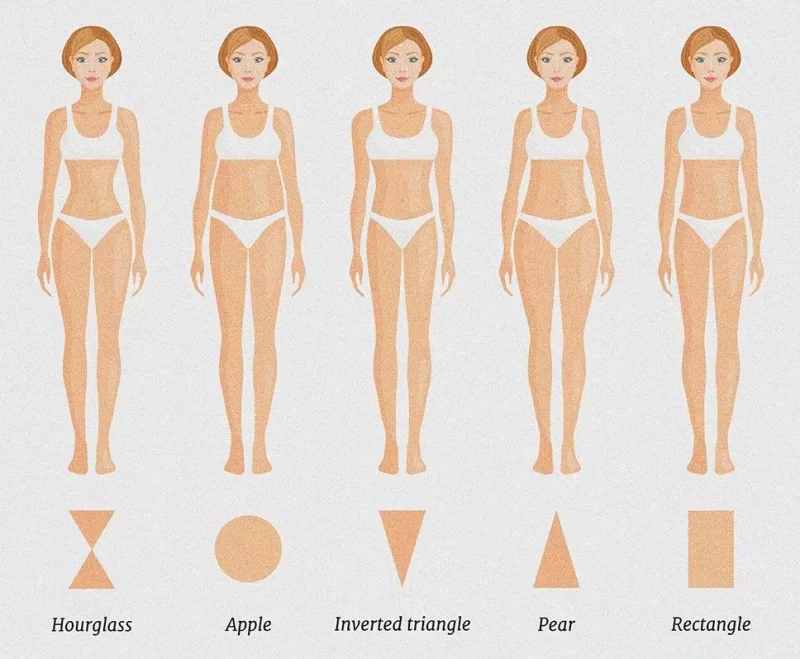
Body shape and buttock shape are closely connected. In aesthetic assessment, surgeons do not evaluate the buttocks in isolation. Instead, they consider how the buttocks relate to the waist, hips, thighs, and upper body. This broader view helps determine whether contouring procedures such as liposuction, fat transfer, or a combination of both are appropriate.
According to standard classification, there are five main body shapes: hourglass, round, inverted triangle, triangular, and rectangular. Each presents different structural characteristics that influence how buttock enhancement can be planned safely and effectively.
Hourglass Body Shape
Around 32% of women have an hourglass body shape, defined by a balanced shoulder-to-hip ratio and a naturally narrow waist.From a surgical perspective, this body type often allows for the most flexibility. Buttock enhancement typically focuses on refinement rather than correction, preserving natural curves while enhancing projection. Liposuction is often used selectively around the waist or flanks to further highlight the contrast between the waist and hips, while fat transfer is applied conservatively to maintain balance.
Round Body Shape
A round body shape does not necessarily indicate excess weight. It is often influenced by skeletal structure and fat distribution around the waist.In patients with this body type, buttock shape is assessed together with midsection contour. Treatment planning may involve strategic liposuction of the waist and lower back to improve overall proportions, combined with fat transfer to the buttocks if additional projection or shape definition is desired. The goal is not exaggeration, but smoother transitions between the torso and lower body.
Inverted Triangle Body Shape
Approximately 10% of women have an inverted triangle body shape, characterised by broader shoulders and narrower hips.In these cases, BBL is often used torestore balance between the upper and lower body. Fat transfer to the hips and buttocks can help widen the lower silhouette visually, while liposuction is rarely the main focus unless there are specific fat deposits affecting symmetry.
Triangular Body Shape
The triangular body shape is the most common, present in about 37% of women. It is defined by hips that are wider than the shoulders.Because this body type already carries volume in the lower body, buttock procedures are planned carefully. Liposuction may be used to refine surrounding areas such as the outer thighs or flanks, while fat transfer to the buttocks is considered only when shape or projection needs adjustment rather than size increase.
Rectangular Body Shape
Rectangular body shapes are the least common, accounting for roughly 9% of women. Hips, waist, and shoulders tend to align with minimal natural curvature.From an aesthetic surgery standpoint, this body type often benefits most from combined contouring approaches. Liposuction is used to create waist definition, while fat transfer to the buttocks and hips can help introduce curvature and soften straight lines. The objective is to build proportion gradually, respecting the patient’s frame and tissue limits.
What If I Want to Change My Butt Shape?

Once people understand their natural buttocks and body shape, a common question follows: can that shape actually be changed? The answer depends on what aspect of the shape is being addressed and which anatomical factors are involved.
In practice, there are three main approaches people consider: lifestyle changes, exercise, and surgical contouring. Each influences the buttocks in a different way.
Diet and Weight Changes
Dieting can reduce overall body fat, but it does not change the underlying shape of the buttocks. Weight loss may reduce volume, but pelvic structure and fat distribution patterns remain the same. As a result, dieting affects size, not form, and may sometimes make the buttocks appear flatter rather than reshaped.
Exercise and Muscle Training
Exercise can improve muscle tone and firmness, especially through glute-focused workouts. However, its impact on buttock shape is limited.
- Muscle makes up only part of buttock volume in most individuals
- Exercise cannot control where fat is stored or removed
- Changes in projection or contour are usually subtle and gradual
For patients seeking visible changes in fullness, curvature, or balance with the waist and hips, exercise alone often falls short.
When Surgical Contouring Is Considered
Because buttock shape is largely influenced by fat distribution and skeletal structure, surgical body contouring becomes relevant for patients who want predictable, proportion-based change rather than minor improvement.
From a clinical standpoint, reshaping the buttocks focuses on two key principles:
- Removing fat from areas that disrupt balance, such as the waist, flanks, or lower back
- Adding volume where projection or fullness is lacking, in a controlled and strategic way
This is where liposuction and Brazilian Butt Lift are used together as complementary techniques.
BBL and Liposuction as Shape-Defining Procedures

In clinical practice, buttock reshaping is never approached in isolation. The appearance of the buttocks is closely tied to the surrounding areas, particularly the waist, flanks, and lower back. For this reason, surgeons evaluate the entire torso before deciding how to use liposuction and fat transfer together. The goal is not simply to add or remove volume, but to adjust proportions so the buttocks appear more projected, balanced, and naturally integrated with the rest of the body.
Liposuction for Proportion
Liposuction plays a critical role in buttock reshaping, even when the goal is not fat removal from the buttocks themselves. By reducing fat from surrounding areas such as the waist, flanks, and back, liposuction enhances contrast and makes the buttocks appear more projected and defined.
In many cases, changes in waist-to-hip ratio have as much visual impact as changes to the buttocks themselves.
Brazilian Butt Lift (BBL) for Shape and Projection
A Brazilian Butt Lift uses fat removed through liposuction to reshape the buttocks. The fat is purified and strategically placed into specific areas of the buttocks to improve:
- Projection
- Curvature
- Symmetry
- Overall balance with the torso
Rather than simply increasing size, BBL focuses on sculpting shape based on the patient’s anatomy, existing buttock type, and body proportions.
Why These Two Are Used Together
BBL and liposuction are not separate goals but part of the same contouring strategy. Liposuction refines the surrounding framework, while fat transfer enhances the buttocks themselves. Together, they allow surgeons to work within natural anatomical limits while achieving a more balanced and intentional silhouette.
This combined approach explains why BBL, supported by liposuction, has become the primary surgical option for patients looking to modify buttock shape rather than just volume.
From Natural Butt Shapes to Surgical Enhancement: BBL in Turkey with MCAN Health
Turkey has become a leading destination for body contouring procedures, particularly for patients seeking balanced, proportion-focused enhancement rather than exaggerated volume. Buttock reshaping with Brazilian Butt Lift and liposuction is increasingly chosen by individuals who want to improve their natural silhouette while respecting their underlying anatomy. At MCAN Health, buttock contouring is planned with a full-torso perspective, recognizing that successful results depend as much on waist and hip balance as on buttock projection itself.
Patients choose MCAN Health for BBL in Turkey for several key reasons:
- Experienced Body Contouring Surgeons: MCAN Health works with board-certified plastic surgeons who specialize in fat transfer and liposuction techniques, with a clear understanding of how different buttock shapes respond to targeted fat removal and redistribution.
- Accredited Surgical Facilities: All procedures are performed in TEMOS-accredited and internationally certified hospitals that meet strict safety, hygiene, and surgical standards.
- All-Inclusive Treatment Experience: Surgery, 4 to 5-star hotel accommodation, airport transfers, post-operative medications, and in-hotel nurse visits are included to support a controlled and comfortable recovery.
- Multilingual Patient Support: Patients are guided by a multilingual care team throughout the entire process, ensuring clear communication from consultation through recovery.
- UK-Based Aftercare Office: Continued follow-up and medical guidance are available after returning home, helping patients monitor healing and long-term contour changes with confidence.
Care That Supports Long-Term Shape and Proportion
MCAN Health’s care approach extends beyond the operating room to support stable, natural-looking outcomes:
- MCANCare: Personalized, nurse-led aftercare with daily hotel visits, incision monitoring, and recovery guidance during the early healing phase.
- MCANFollow: A structured 12-month follow-up program designed to support long-term healing and contour stability.
- MCANAssurance: Coverage that provides reassurance in the unlikely event that additional care or revision is required.
At MCAN Health, buttock reshaping is not planned around trends or a single “ideal” shape. Each treatment strategy is based on the patient’s existing buttock type, pelvic structure, fat distribution, and overall body proportions. This measured approach helps ensure results that look natural, settle predictably, and remain balanced as the body changes over time.


 Male Rhinoplasty: Preserving and Enhancing the Masculinity
  Puffy Nipples: What Are They and How to Get Rid of Them?